The Connection Currency
Information is easier to access than ever. So what are buyers actually paying for?


In 2016, I was working full-time for Ramit Sethi.
I managed a 15-person team that ran 12-18 course launches per year. And at the time, most of our sales came from self-paced DIY video courses.
No community. No coaching. And no personalized support (unless you upgraded).
We charged $1,000-$2,000 per course, and regularly earned 6-7 figures per launch.
That model worked exceptionally well at the time, and Ramit still offers some of those best-sellers today.
But over the last decade, his courses have evolved alongside a broader shift from content-driven to connection-driven programs.
For example, one of his current flagship programs, Earnable, is a subscription-based membership. And you can upgrade to join a peer community and attend monthly calls hosted by Ramit.
He also introduced a $20/mo membership called Money Coaching, which includes live workshops and access to an AI Ramit Bot, “which can answer your specific money questions 24/7.”
I doubt anyone at the company (myself included) would’ve pitched an offer like that in 2016.
But in 2026, it reflects the increased importance of community, interaction, and ongoing support for modern buyers.
So this issue explores that shift and how it’s reshaping the way digital programs are designed.
Signal #1: AI commoditizes information, but not connection.
In a previous issue, I shared how basic information can now be easily surfaced and summarized by AI.
You can check it out here:

But when people need to make nuanced decisions, information alone isn’t enough.
Instead, as this article from Higher Logic explains:
“They look to other people for what data can’t provide: firsthand experience, unfiltered opinions, edge cases, and the kind of context that only comes from someone who has actually done the thing.”
This highlights a key limitation of AI. It can surface answers, but it can’t share a lived experience.
So as information becomes more accessible, connection becomes more valuable.
Signal #2: Community is shifting from “nice-to-have feature” to “core offer.”
I noticed this shift starting in 2020, when I was still working at Teachable and running Wit & Wire as a side business.
At the time, COVID played an obvious role in the growth of online communities. And in June 2020, Teachable introduced basic community features to its platform, with more meaningful updates in 2024.
Other course creation platforms have followed a similar timeline:
Circle launched in 2020 to fill an industry gap as a dedicated community platform
Thinkific added a community feature in 2022, with a major refresh in April 2026.
Kajabi added a community feature in 2023, with a major update in December 2025.
ThriveCart added a community feature in May 2026.
But these product updates weren’t coincidental. They were prioritized because users asked for them.
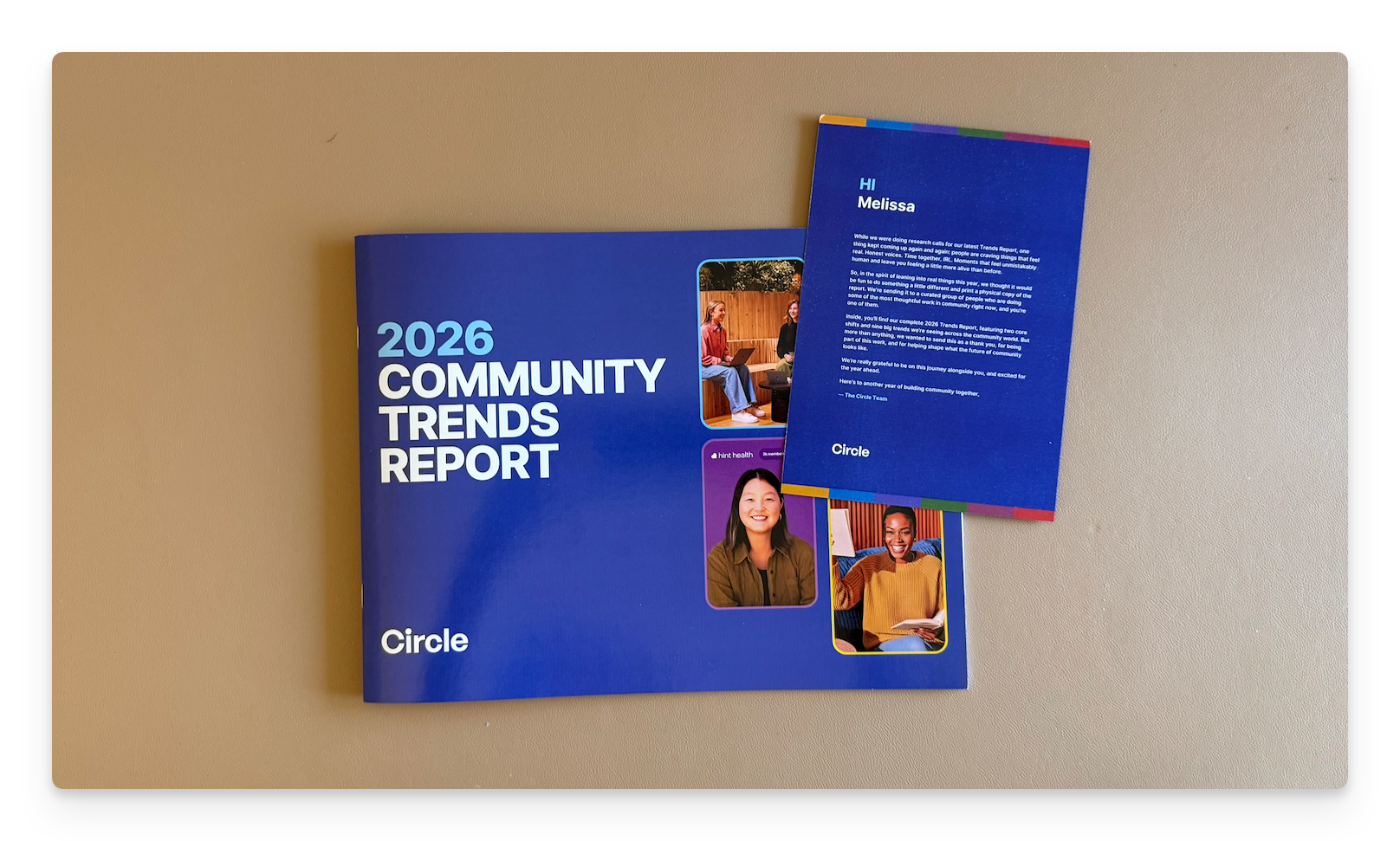
That demand shows up clearly in recent surveys, too. In Circle’s 2026 Community Trends Report, 69% of respondents said that community will be a bigger part of their overall strategy in 2026.
And perhaps even more illuminating is this year-over-year comparison from Circle’s last two reports:
In 2025, 54% of creators surveyed offered paid memberships
In 2026, 88% of creators surveyed offered paid memberships (a 34% increase)
Signal #3: Retention is driven by belonging, not just content.
People can watch billions of YouTube videos for free. Or access an ever-expanding Netflix library for less than $10/mo.
But as solo business owners, we’re not selling entertainment. We’re offering transformation. And watching videos is just the first step toward action and change.
Unless you’re highly self-motivated, that’s hard to do alone.
According to Circle, “when people feel seen, connected, and part of something bigger than themselves, they don’t just engage — they stick around.”
In their 2026 Community Trends Report, 67% of respondents said their members joined or stayed because of shared identity and values.
So while information via videos, resources, templates, and even AI prompts gets people started, it’s their sense of belonging and accountability that help them follow through.
But that feeling doesn’t happen by accident; it’s by design.
That’s why platforms like Circle have become increasingly valuable and central for solo business owners. (It’s been my top-recommended community platform since 2020, and it’s what I personally use to run Solo Studio.)
With Circle, you can build member connections through focused discussions, private virtual events, and livestreams. Plus, your members can DM privately or in small groups to further those discussions and relationships.
My members regularly tell me how much they enjoy using Circle, and how easy both the web browser and mobile app are to use.
And personally, I’ve found that the community layer of my business hasn’t just become profitable, but also deeply enjoyable. I genuinely love working with the solo business owners in my community, and it’s really rewarding to watch them support, encourage, and learn from each other.
That’s the kind of transformation that content alone can’t replicate, nor replace.
Disclosure: Thank you to Circle for agreeing to sponsor this issue of Solo Signals after I pitched them the concept!
What this means for solo business owners
When information was scarce, it was worth a premium. (That’s why Ramit and his peers could charge thousands for DIY self-paced video courses a decade ago.)
But now that information is widely accessible, we have to ask: what are modern buyers actually willing to pay for?
As Stefano Puntoni, Sebastian S. Kresge Professor of Marketing and Co-Director of Wharton Human-AI Research, puts it:
“Double down on what can’t be replicated by AI. Human experiences are irreplaceable. Shift your focus away from purely informational content and build interactive communities, emotional connections, and shared experiences (e.g. webinars, live streaming).” (Science Says)
It’s connections with you and with peers that elevate both the value and the price point of today’s top programs.
And buyers now evaluate their options based on the level of accountability and support provided.
That doesn’t mean that mini products (aka low-ticket offers) will disappear. In fact, I think bite-sized time savers will continue to sell well in an age of instant gratification.
But for signature (aka high-ticket) programs, it’s worth considering interactive additions, like group calls, shared discussion spaces, live cohorts, peer connections, or accountability challenges.
These touchpoints can complement your self-paced materials. And as Circle reports:
“In the near future, pricing power in the creator economy will increasingly come from intimacy rather than scale. Creators will intentionally limit access through capped memberships, cohorts, and smaller groups, allowing them to deliver more direct feedback, accountability, and hands-on support.”
This challenges the definition of “passive” income, though I’ve always found that phrase more aspirational than accurate.
Increasingly, the programs that can command the highest prices are the ones built around connections, not just content. Where access to you - or a community of peers - is part of the offer.
And for solo business owners, that’s an advantage worth claiming.
Disclosure: This issue contains affiliate links.
Want to build your own community? 👥
I test a lot of online business platforms. Circle has been my #1 choice for the best community platform for solo business owners for 5+ years, and I’ve personally been a paid customer since they launched.
My students regularly tell me that they love their experience inside the Wit & Wire community, and I appreciate that Circle regularly releases new features to stay up-to-date with modern creators’ needs.
I whole-heartedly recommend their platform, and I’m grateful to Circle for partnering with me on this issue of Solo Signals. (After I read their 2026 Community Report, I knew it would be a perfect fit, so I pitched them on the concept.)
And if you’re thinking about building your own community, you can start a free trial at witandwire.com/circle (partner link).
They’re also hosting a free event on June 16 called Circle Eclipse, which will “mark a new era for digital businesses.”
Oh! I am here because you imported my email address to substack :) I am so curious about that process and how you decided the minutiae of it! I have 9K email subscribers on Kajabi and have not yet imported that list over here to substack.